Why USDT on Binance P2P costs more than the exchange rate
Take an ad on Binance P2P and the price per USDT is usually a little above the dollar rate your bank shows. That gap is the premium. You won't find it as a fee line on the order: it is baked into the ad price, so the money you send is the same and the USDT you receive is slightly less.
That is why "no fee on this order" tells you very little. Work backwards from what arrived:
USDT the same money buys at a reference rate = amount paid ÷ reference rate
The difference between those two numbers is what the premium cost you. Everything you need is on the order details screen plus one public rate.
Work out the premium on a GEL order
Open the finished P2P order and copy three things: the price, the total you paid in GEL, and the quantity of USDT. Paid ÷ price should equal the quantity, give or take rounding in the last decimal.
Then pick a reference rate for the time you ordered. For lari there are two obvious ones:
- The National Bank of Georgia's official rate. It is published per day on the NBG site, and the page itself calls it "an indicative rate". Good for a consistent yardstick, not a rate any bank will actually give you.
- Your bank's USD selling rate. This answers the practical question: would buying dollars from my bank have been cheaper? Keep in mind USDT trades around 1 USD, not always exactly at it.
Either works. Write down which one you used and stick to it next time. With made-up numbers:
Ad price 2.65 GEL, paid 1,500 GEL
Received: 1,500 ÷ 2.65 ≈ 566.04 USDT
At the reference rate: 1,500 ÷ 2.60 ≈ 576.92 USDT
Premium: 2.65 ÷ 2.60 − 1 ≈ 1.92%, about 10.88 USDT fewer
Five tetri per coin looks like nothing on the ad list. On 1,500 GEL it is more than ten USDT.
Official source · National Bank of Georgia · Official exchange rate of lari against foreign currencies (checked October 2026)
Fixed-price and floating-price ads: why the price keeps moving
Binance explains where ad prices come from in its help article "How to Post P2P Trading Advertisements via Binance App?". It is written for advertisers, and step 3 sets out two pricing types:
- Fixed: "Your ad price is fixed and does not move with the market price of the crypto."
- Floating: "Your ad price fluctuates with the market and is refreshed every minute", calculated as Market Reference Price × Floating Price Margin. A 105% margin lets the ad sit up to 5% above the current market price; 95% puts it up to 5% below.
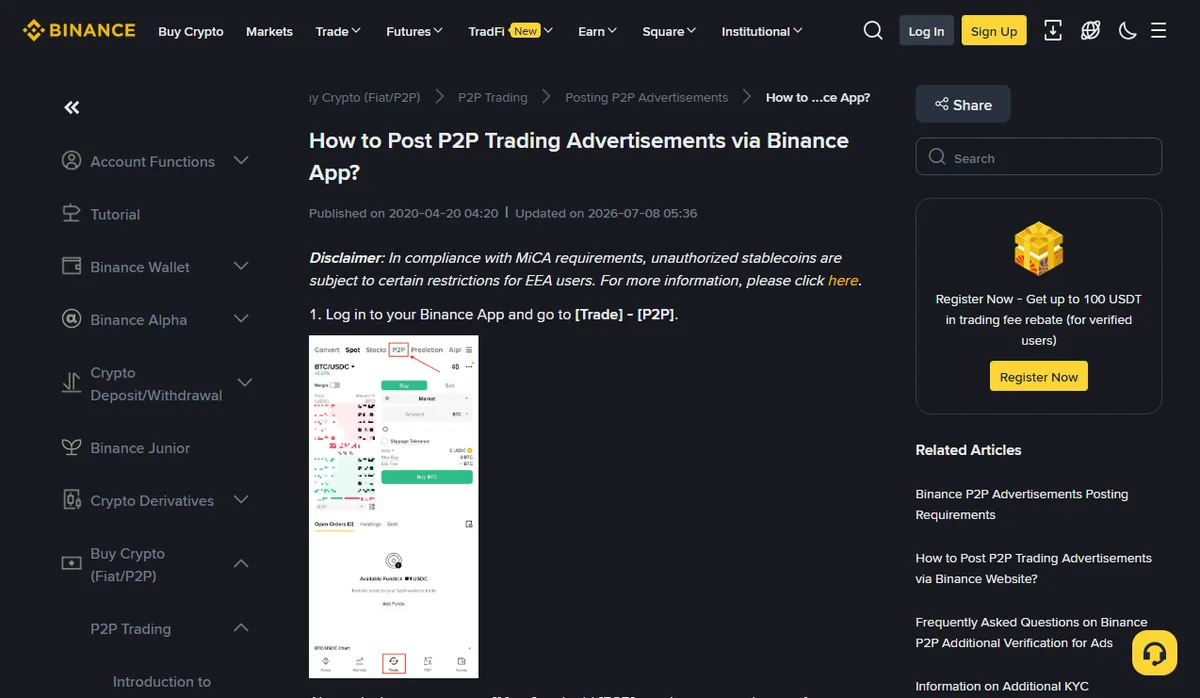
October 2026
Two things follow for you as the buyer. Use the price on the order itself when you calculate, not the one you glanced at in the list: a floating ad can refresh between the list and the order. And a fixed-price ad does not follow the market at all, so after a sharp move it can sit well away from where everything else is priced. The formula in the previous section shows it straight away.
The help article does not say what the market reference price is drawn from. Your premium against the NBG or bank rate will not match the advertiser's margin, and it doesn't need to.
Official source · Binance · How to Post P2P Trading Advertisements via Binance App? (page marked updated 8 July 2026, checked October 2026)
Buy, then sell straight back: the gap between the two sides
P2P ads come in two directions. At any moment, ads selling USDT to you are usually priced above ads buying USDT from you. If you change your mind right after buying, you sell back on the lower side.
Round-trip loss: (2.65 − 2.57) ÷ 2.65 ≈ 3.02%
You can check this before you order: switch to the sell side and look at the top prices for the same payment method. A wide gap means that method is thin at that hour. Easy to get in, costly to get out. If you only need USDT for a short time, this number matters more than the premium.
Add what your bank charged: the real cost per USDT
On P2P you pay the other person from your own bank or payment account. Whatever that transfer costs never appears on the Binance order, so pull it from your bank statement and add it on top:
Same example, assuming a 1 GEL transfer fee: 1,501 ÷ 566.04 ≈ 2.6518 GEL
That figure is the one to set against other routes. How card purchases and conversions spend your lari is in Buying crypto with GEL; if you are weighing Convert against a Spot order, see Convert or a Spot market order.
One condition that is not about price: GEL is not among the currencies that Binance's help article What Are the "T+1" and "T+2" Withdrawal Limits? puts under the 24-hour T+1 withdrawal hold, a list Binance can extend. The T+2 rule can still reach you: if Binance's risk control system detects abnormal activity on an account, all withdrawal functions are disabled for 48 hours, in any market. Details in the T+1 and T+2 limits. Coins bought on P2P land in your Funding account; if you can't find them in Spot, see bought crypto but it's not in Spot.