Does the T+1 limit apply to your P2P purchase?
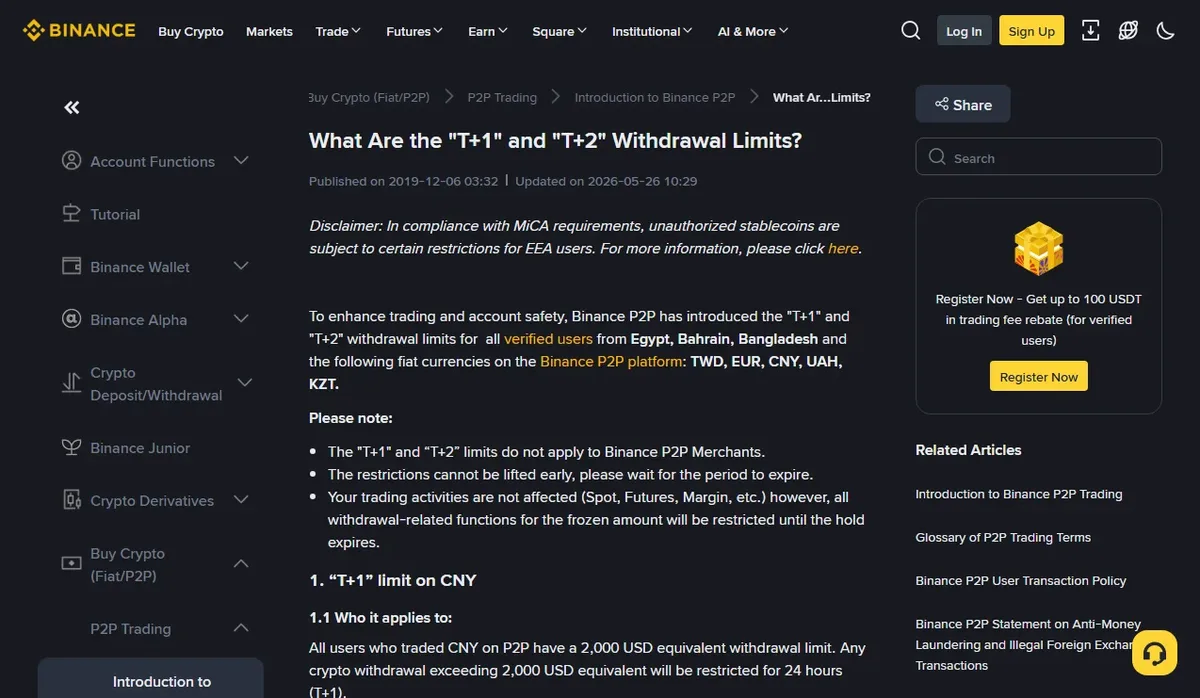
The article is titled What Are the "T+1" and "T+2" Withdrawal Limits? and sits under Buy Crypto (Fiat/P2P) → P2P Trading → Introduction to Binance P2P. Its opening line names two groups: all verified users from Egypt, Bahrain and Bangladesh, and P2P trades in TWD, EUR, CNY, UAH and KZT.
October 2026
Who is actually caught depends on the currency:
- EUR and TWD: anyone who completes a P2P buy order.
- UAH, KZT and BYN: only maker-buyers, meaning you posted the buy ad yourself and a seller came to you. BYN appears in that section's heading but not in the opening list.
- CNY: every user who trades CNY on P2P.
- Egypt and Bahrain: verified users who complete a P2P buy order. Bangladesh: maker buy orders only.
Binance P2P Merchants are exempt. If you tapped someone else's ad to buy, that exemption is not yours.
Official source · Binance · What Are the "T+1" and "T+2" Withdrawal Limits? (page marked updated 26 May 2026, checked October 2026)
Bought with EUR: part of the deposit is held for 24 hours
For EUR and TWD buyers the wording is that a portion of the assets deposited through P2P is frozen for 24 hours from the time of purchase, then released automatically. The article does not say how big that portion is, so there is nothing to calculate in advance. What you can check is the gap between the balance you see and the amount the withdrawal screen lets you send.
Two things are not affected. Spot, futures and margin trading carry on as normal; only withdrawal-related functions for the frozen amount are blocked. And P2P purchases land in the Funding account first: the P2P glossary (question 11) says to transfer them to Spot before trading. If you can't find the coins at all, that's a different problem, covered in bought crypto but it's not in Spot.
Support cannot shorten the wait. The article says the restrictions cannot be lifted early and you have to let the period run out.
If you buy on P2P intending to move the coins to your own wallet straight away, count the day's wait as part of the deal when you compare it with other ways to pay. The network fee for the transfer itself is broken down in the cost of sending crypto to your own wallet. The article only covers P2P; it says nothing either way about card purchases.
The CNY rule is a cap, not a share
CNY works differently. Up to 2,000 USD equivalent can be withdrawn immediately; anything above that is held for 24 hours and then released. That 2,000 USD figure is what the article showed in October 2026 and Binance can change it, so look it up again before a large CNY purchase.
The article's own example: an account already holds 5,000 USDC, then buys 1 BTC on P2P with CNY. Total assets are 1 BTC plus 5,000 USDC, yet the withdrawal limit is 2,000 USD equivalent. The USDC that was already there sits under the same cap.
Withdrawable now: about 2,000 USDT
Waits out the 24 hours: 3,500 − 2,000 = 1,500 USDT
The Egypt, Bahrain and Bangladesh section has one extra line: during the hold, funds moved from the Funding account to another Binance account can't be moved back to Funding.
T+2: a 48-hour stop on all withdrawals
T+2 has nothing to do with which currency you used. If Binance's risk control system detects abnormal activity on an account, every withdrawal-related function is disabled for 48 hours, in all markets.
So T+1 freezes part of a P2P deposit for listed currencies, while T+2 switches off withdrawals for the whole account. The article does not list what counts as abnormal activity, and we won't guess.
Binance's stated reason for both is a 24 to 48 hour buffer against illicit fund flows and money laundering, and fewer frozen bank accounts for merchants and users. A P2P trade is a bank transfer between two people, which is why the hold sits on the crypto side.
Still blocked and none of this fits
Say you paid in a currency that isn't on the list, or the coins didn't come from P2P at all. Then this article isn't the explanation. Before contacting support, gather:
- the exact message on the withdrawal screen or in your notifications, with the time it appeared;
- where the coins came from: the P2P order number with payment and release times, a card order, or an incoming deposit;
- the amount you tried to send and the amount the screen showed as available.
How to lay these out so support can find the same transaction is in preparing purchase records for support. If the seller never released the coins in the first place, see the P2P appeal guide. If the amount is simply below the withdrawal minimum, that is covered in bought too little to withdraw.