Why selling straight back returns less than you paid
A filled buy order can't be undone. Getting back to where you started means placing a second order in the other direction, and the pair of trades is a round trip. Whatever goes missing on the way comes from one of these:
- The fee on the buy. Spot trades are charged on the filled amount. Without BNB fee deduction it usually comes out of the coin you received.
- The fee on the sell. Charged again, this time from the USDT you got for the coin.
- The spread. At any given moment a market buy pays the best ask and a market sell gets the best bid, and the ask is always the higher of the two. Large orders that eat through several levels of the book drift further.
- The price moving between the two trades. This can go either way, so it isn't a cost, but it lands in the same gap as the other three.
If the money came in from a card or through P2P and has to leave as fiat again, both ends add costs that never appear on a trade. Those are in the last section.
Which numbers to copy from the buy and sell orders
From each order, note three things: average fill price, filled quantity, and the fee together with the asset it was charged in. The asset matters, because each way of charging the fee needs converting differently; Which currency paid your trading fee? walks through them.
Here is a made-up example. Spot market orders, a regular user's 0.1% taker fee, each fee taken from the side you receive:
Filled 800 ÷ 2.5030 ≈ 319.6165 coins, fee 0.3196, credited 319.2968
Sell: 319.2968 coins at an average 2.4990
Proceeds ≈ 797.9228 USDT, fee ≈ 0.7979, received ≈ 797.1249 USDT
Lost on the round trip ≈ 2.8751 USDT, about 0.36%
Broken into parts:
Sell fee: ≈ 0.7979 USDT
Price: (2.5030 − 2.4990) × 319.2968 ≈ 1.2772 USDT
Total ≈ 2.8751 USDT
The two fees would be about the same whenever you did this. The price part is harder: from the orders alone you can't tell how much of it was spread and how much was the market slipping during that minute. Jot down the best bid and best ask when you place the buy, and you can split it: ask minus bid is the spread, the rest is movement.
Estimating the minimum loss before you place anything
There's no need to actually buy and sell to find out. The top of the order book plus two taker fees gives the least you'd lose by buying now and selling now:
Ask 2.5020, bid 2.5010 (assumed): 0.0010 ÷ 2.5020 ≈ 0.04%
Plus 2 × 0.1% gives roughly 0.24%
The fee comes from Binance's Spot & Margin fee table: a Regular User pays 0.100% maker and taker, or 0.07500% with BNB deduction. Market orders pay the taker rate, so with BNB the two fees together drop from 0.2% to 0.15%. Higher VIP tiers have their own numbers, and the table can change, so plug in the rate the page shows when you trade.
Treat the result as a floor. An order that's large relative to the book fills across several levels and averages above the best ask, and on thinly traded coins the gap between bid and ask can easily outweigh both fees. For working out a weighted average across fills, see Partial fills: average price and net amount.
If the aim is a small first purchase just to learn how the screens work, a loss around 0.2% on the way back out is a reasonable price for that, provided the amount is small. If the plan is to trade in and out often, multiply the formula by the number of trips first: in the assumed figures above, each trip costs 0.2% in fees against 0.04% of spread, so repeated trips mostly pile up fees.
Official source · Binance · Spot trading fee rates (checked October 2026)
Bought with Binance Convert? Preview the reverse trade to see the cost
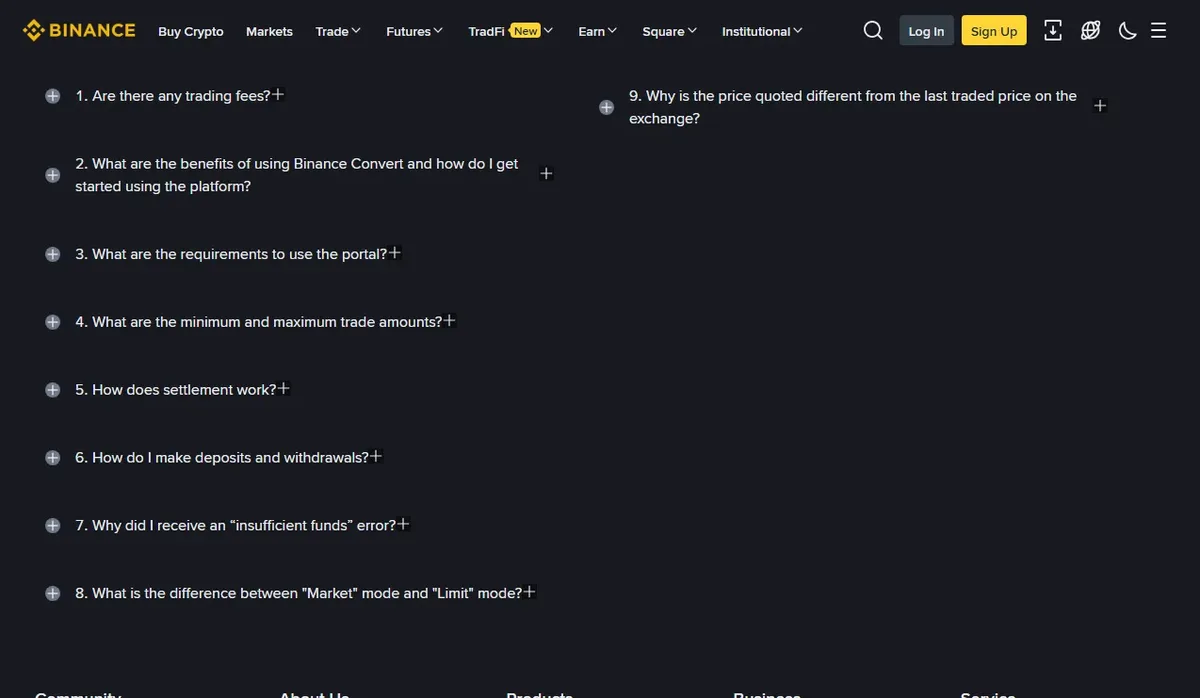
Convert has no fee line to split out. Question 1 of Binance's Convert FAQ says it does not charge trading fees and that the quoted amount shown is what your account receives after the conversion. Question 9 explains why a Convert quote differs from the last traded price: that price leaves out trading fees and ignores the size of your trade. Everything is in the quote, so compare quantities instead.
October 2026
After the purchase, swap the two assets in Convert, type in the amount you just received, and look at the preview without confirming it:
Reverse preview: enter 319.04 coins, you would receive 796.62 USDT
Round-trip cost right now: 800 − 796.62 = 3.38 USDT, about 0.42%
Previews expire and the figure can change when it refreshes, so compare two previews taken close together. If the reverse preview complains about an insufficient balance, check where the coins went first: question 5 says Convert settles into your Spot or Funding wallet, whichever you selected.
Official source · Binance · Convert FAQ (checked October 2026)
Bought with a card or through P2P and cashing back out: the costs outside the order
Everything above is about moving between a coin and USDT inside the platform. When the money started as fiat, two more legs belong in the sum:
- Coming in. Card fees and any currency conversion margin stay paid after you sell. If the bank took more than the order showed, Card charged more than the crypto order? shows where to look.
- Both sides of P2P. Buy ads are usually priced above the sell ads posted at the same time, and buying and then selling through P2P tends to cost far more than the bid-ask gap on Spot. Section 5 of the P2P premium guide has a worked example.
- Going out. Whether withdrawing fiat to a bank costs anything, and how much, depends on the method you use; check it on the withdrawal page, because it differs a lot by region and channel.
So before deciding how much a quick buy-and-sell really lost, settle which leg you're measuring. USDT in and out: sections 2 and 3. Counting from your own currency: add both fiat legs on top.