Where buying USDT first can save money: it skips the 2% card fee
The usual advice is that going through USDT is always cheaper, with the reasoning stopping at "more USDT pairs, lower fees". Laid side by side, the extra swap saves nothing on its own. It adds one more Spot fee. What saves money is that the first step uses a different way to pay:
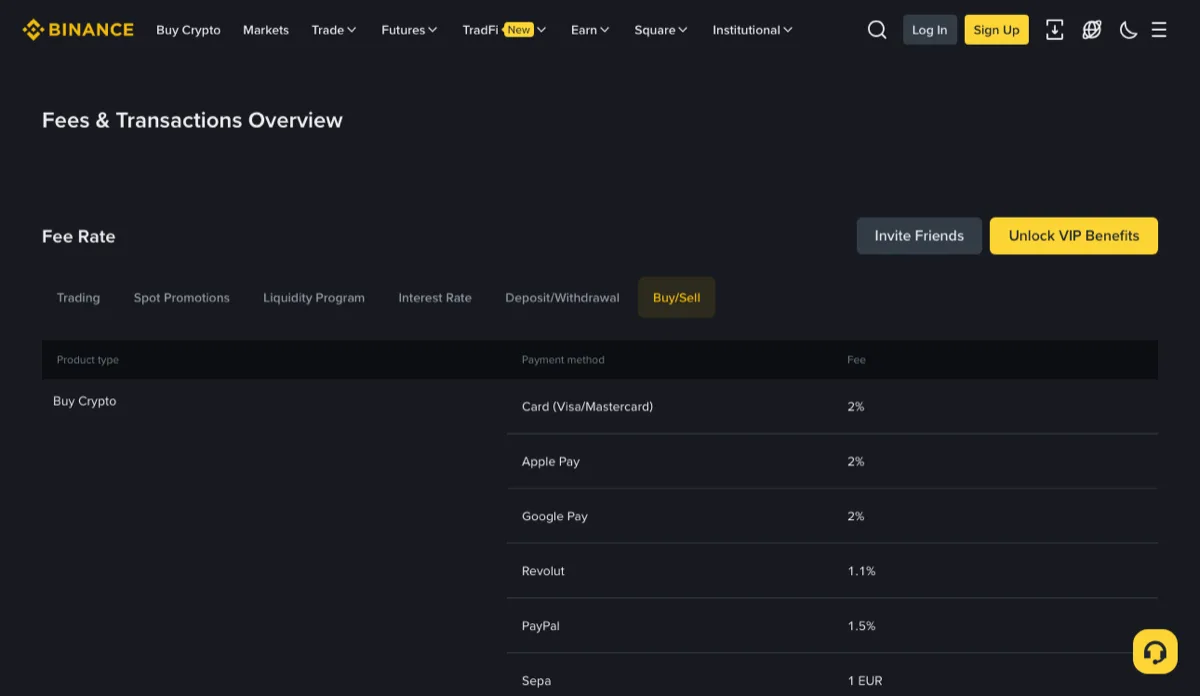
- Direct route. On Binance's Buy/Sell fee tab, Buy Crypto paid by Card (Visa/Mastercard) costs 2%. Apple Pay and Google Pay are also 2%, PayPal 1.5%, Revolut 1.1%, and Sepa 1 EUR.
- USDT first. If the USDT comes from P2P, the P2P tab of the same fee page shows a 0.1% taker fee for USDT in its default fiat view, with a note that P2P user levels get different discounts and that you see your own rate after logging in. The Spot swap to BTC is 0.100% taker for a Regular User. Together that is about 0.2%, but a P2P ad price may carry a premium.
November 2026
So the real question is whether a 2% payment fee is bigger than the P2P premium plus two 0.1% fees. And if the USDT was itself bought by card through Buy Crypto, both routes have already paid the 2%. The detour then only adds another 0.1%, and section 4 shows how little that changes.
Official source (fees change; go by what the page shows when you order) · Binance · Buy/Sell fees (checked November 2026) · Binance · Spot trading fee rate, including the P2P tab (checked November 2026)
Buying BTC directly with a card: the Receive amount on the confirm screen is the number to compare
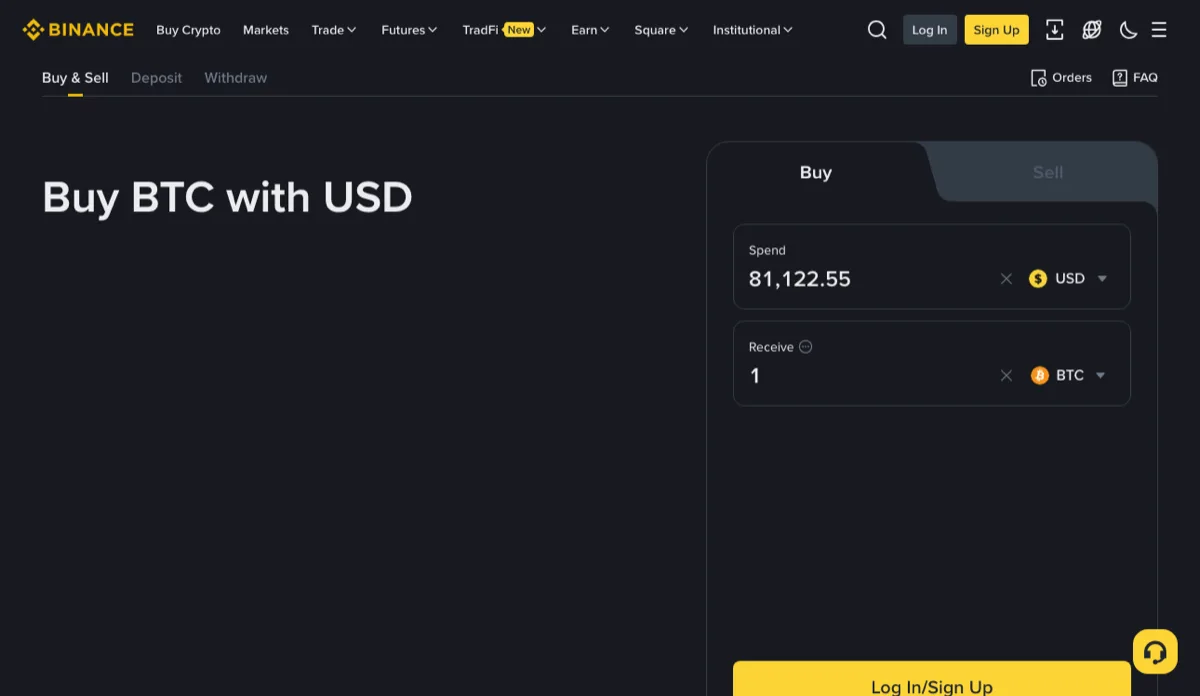
The Buy Crypto page has two boxes: Spend, where you type the fiat amount, and Receive, which shows how much BTC that buys.
November 2026
Copy the Receive amount from the screen you reach after logging in and choosing a card, just before you confirm. Whatever share of the payment fee applies is already inside that number, so do not subtract it again. Spend and Receive are all you need:
Example: spend $1,000, confirm screen shows 0.01206897 BTC
Per BTC ≈ 1,000 ÷ 0.01206897 ≈ $82,857
Those example figures were built by taking 2% off $1,000, leaving $980, and converting at a quoted $81,200 per BTC. The confirm screen may not break it down that way. You don't need it to.
One charge may never appear there. If your card issuer books the purchase as a cash advance, the bank adds its own fee and interest. How to recognise that line and fold it into your cost is covered in the cash advance guide.
Buying USDT first, then BTC: what to copy from each order and how to combine them
This route leaves two orders behind. From the P2P order, note the price per USDT, the fiat you paid and the USDT actually credited. From the Spot order, note the average fill price, the filled quantity, the fee and which coin it came out of.
After 0.1%: ≈ 993.0417 USDT credited
Step 2, Spot: 993.0417 ÷ average fill 81,100 ≈ 0.01224466 BTC
After 0.1%: ≈ 0.01223241 BTC credited
Per BTC ≈ 1,000 ÷ 0.01223241 ≈ $81,750
The same result in one line:
1.006 × 81,100 ÷ (0.999 × 0.999) ≈ $81,750
This assumes both fees come out of what you receive. With BNB fee deduction switched on, the Spot fee no longer comes out of the BTC: change that 0.999 to 1, and add the BNB you paid, valued at the time, to your spend. Which currency paid your trading fee explains how to record each case without counting it twice. If step 2 is a Convert instead of a Spot order, use the Convert preview amount in place of "divide by the fill price, then take off 0.1%"; Convert versus a Spot market order compares the two.
Under these assumptions the USDT route costs about $1,100 less per BTC and leaves you with roughly 1.35% more coin.
How high can the P2P price of USDT go before the detour stops paying?
That 1.35% rests on a P2P price of 1.006. Hold the direct cost fixed and you can solve for the highest P2P price at which the detour still breaks even:
82,857 × 0.999 × 0.999 ÷ 81,100 ≈ $1.0196
In this example, once a P2P ad asks more than about $1.0196 per USDT, around 2% over one dollar, buying USDT first stops giving you more BTC and still costs you an extra wait. Ad prices move with the merchant and the hour; working out the P2P premium from your order shows how to measure it against a reference rate.
A different detour is also common: buy USDT by card through Buy Crypto, then swap on Spot. Here step 1 has already paid the 2%.
Step 2: 980 ÷ 81,100 × 0.999 ≈ 0.01207176 BTC
Direct: 0.01206897 BTC, a gap of about 0.02%
That sliver exists only because the direct quote (81,200) sits a little above the Spot fill (81,100), and most of it is eaten by the extra 0.1%. How far the direct quote sits above Spot changes from one purchase to the next, so compare both routes at the same moment.
Three things the formula leaves out: the gap between steps, withdrawal holds, small-amount minimums
A few things stay outside the arithmetic and can still flip the answer.
- Time passes between the two steps. On P2P you pay and wait for the seller to release. By the time you place the Spot order, BTC is no longer at the price you planned with. The move can go either way. It is not a cost, but it is why the final amount rarely matches the estimate. If the seller is slow to release, what to keep before you appeal lists the records worth saving.
- Crypto bought on P2P can be held from withdrawal. Binance applies T+1 and T+2 withdrawal limits to assets bought on P2P. If you plan to move the BTC to your own wallet straight away, read the T+1 and T+2 guide first for which currencies are covered, how much is held and for how long.
- Small amounts hit minimums. Step 2 may run into the Spot minimum order size, and the BTC you get may fall short of the minimum withdrawal. Bought too little to withdraw covers the options.
For a single, modest purchase you want to withdraw today, the direct route buys you one less wait and one less restriction for that extra percent or two. For a regular monthly purchase of a meaningful size, the price ceiling in section 4 is worth recalculating with that day's numbers before each order.